

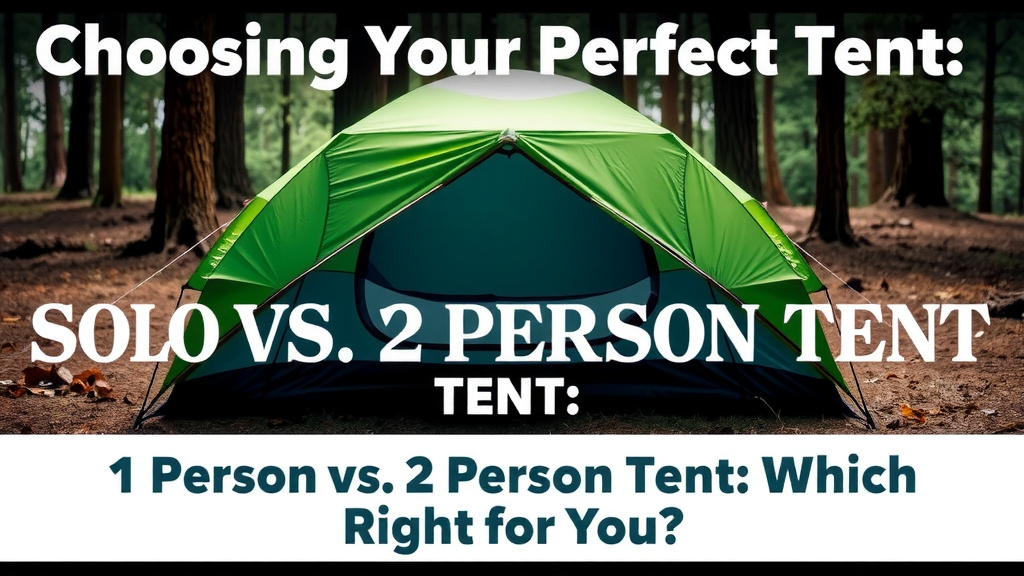
1 Person vs 2 Person Tent: Which is Right for You
Choosing between a 1-person tent and a 2-person tent really comes down to your camping style and who you’re bringing along. A 1-person tent is ideal for solo adventurers who prioritize lightweight and minimal gear. A 2-person tent offers more space and comfort, especially if you don’t mind carrying a little extra weight or are camping with a partner.
We found that while size is the main difference, factors like packed weight, interior space, and even setup difficulty can vary widely between models. Thinking about your typical camping trips and whether you’re a minimalist or prefer a bit more room will help you decide. It’s not just about fitting one person or two; it’s about your overall camping experience.
- A 1-person tent is best for solo campers seeking light, compact gear.
- A 2-person tent offers more room, good for couples or those who like extra space.
- Consider packed weight and ease of setup for your chosen tent.
- Your typical camping trip dictates whether solo or shared space is better.
- Think about comfort vs. portability to make the right choice.
Let’s break down the pros and cons of each to help you pick the perfect tent for your next outdoor adventure.
Choosing Your Perfect Tent: Solo vs. Companion Camping
Deciding between a one-person and a two-person tent is a big step in planning your outdoor adventures. Your choice really hinges on your personal needs and who you’re sharing the experience with. We’ve found that this decision impacts everything from how much you carry to how comfortably you sleep.
The Case for the Solo Traveler: 1-Person Tents
If you’re heading out on your own, a 1-person tent can be your best friend. These tents are designed with the solo hiker and backpacker in mind. They prioritize lightweight construction and a small packed size. This makes them easy to carry on long treks.
Weight Matters When You’re Alone
When you’re carrying all your gear yourself, every ounce counts. We found that 1-person tents often weigh less than 3 pounds. Some can even be under 2 pounds. This makes a huge difference when you’re climbing mountains or covering miles each day. You’ll feel less fatigued and can enjoy your hike more. Think of it as having more energy for the views instead of just for carrying your shelter.
Compact and Efficient Design
Beyond weight, these tents are typically very compact when packed. They can easily fit into smaller backpacks. This is great for ultralight backpackers or anyone who likes to travel with minimal gear. The design is usually simple, focusing on essential features to keep the weight down.
Is a 1-Person Tent Right for You?
Ask yourself if you truly enjoy your own company in nature. Do you like having just enough space for yourself and your gear? If your trips are mostly solo expeditions and you value portability above all else, a 1-person tent is likely your ideal choice. It’s designed for your personal space without unnecessary bulk.
More Room to Roam: 2-Person Tents
Now, let’s talk about 2-person tents. These are the go-to for many campers. They offer more space, which can mean more comfort. Even if you’re camping alone, a 2-person tent can provide a more luxurious experience.
Comfort and Space for Two (or One!)
The primary advantage is obvious: space. A 2-person tent provides room for two people to sleep comfortably. It also means more space for gear inside the tent, keeping you organized and dry. Many solo campers also opt for a 2-person tent. Why? They get extra elbow room, space to change clothes easily, or even a small area to sit up and read a book.
We found that the interior dimensions can vary a lot. Some are snug, while others feel quite spacious. If you’re sharing with a partner, consider your combined size and how much gear you typically bring. A little extra space can prevent a lot of nighttime friction!
Packed Weight and Portability Considerations
While 2-person tents are heavier than their 1-person counterparts, the difference isn’t always dramatic. Many modern 2-person tents weigh between 3 to 5 pounds. This is still quite manageable for most campers, especially if you’re car camping or splitting the weight with a partner. If you’re backpacking, one person can carry the tent body, and the other can carry the rainfly and poles.
Ease of Setup and Versatility
Often, 2-person tents are designed for straightforward setup. Many feature color-coded poles and simple clip systems. This means you can get your shelter up quickly, even in challenging weather. The versatility of a 2-person tent is a major draw. It can serve a couple perfectly, or a solo camper looking for extra comfort and storage.
Key Factors to Compare: Beyond Just Size
When you’re comparing tents, don’t just look at the person rating. Several other factors play a big role in your camping experience. We’ve identified the most important ones to consider.
Packed Weight: Your Backpacking Buddy
As we’ve touched on, weight is critical, especially for backpacking. A general rule we found is that 1-person tents average around 2-3 pounds, while 2-person tents can range from 3-5 pounds. Always check the “packed weight” or “total weight” listed by the manufacturer. This is the weight of everything that comes in the stuff sack.
Interior Space: Your Home Away From Home
Tent floor dimensions are key. A typical 1-person tent might be around 20-30 square feet. A 2-person tent often ranges from 30-50 square feet. Look at the peak height too. Can you sit up comfortably? This makes a big difference for morale on rainy days. We recommend looking at floor dimensions in feet or meters to get a real sense of the space.
Ease of Setup: Your First Impression
You want to get your tent up quickly so you can relax. Look for tents with simple pole designs, color-coded components, and easy-to-use clips. Freestanding tents are often easier as they can be moved and adjusted before staking. Practice setting up your tent at home before your trip.
Durability and Weather Resistance
No matter the size, your tent needs to withstand the elements. Check the denier of the fabric (higher numbers usually mean more durable). Look for waterproof ratings (hydrostatic head) for the rainfly and floor. Many experts suggest a waterproof rating of at least 1500mm for light rain and 3000mm or higher for more challenging conditions (REI Co-op).
Ventilation: Avoiding Condensation
Good ventilation is vital to prevent condensation inside your tent. Look for tents with mesh panels, adjustable vents, and good airflow between the rainfly and the tent body. This is important for both 1-person and 2-person tents to keep you dry and comfortable.
| Feature | 1-Person Tent | 2-Person Tent |
|---|---|---|
| Primary User | Solo Adventurer | Couples, Friends, Soloists wanting extra space |
| Packed Weight | Lightest (often 2-3 lbs) | Moderate (often 3-5 lbs) |
| Interior Space | Minimal, just enough for one | Comfortable for two, or spacious for one |
| Portability | Excellent for ultralight | Good, especially if shared |
| Cost (General) | Often less expensive | Can be more expensive |
| Versatility | Niche, solo focus | Broad appeal, solo or pair |
Making Your Final Decision: A Quick Checklist
To help you narrow it down, consider these questions:
- Will you always be camping alone?
- How much gear do you usually pack?
- Does weight or packed size matter most for your trips?
- Do you prefer cozy or more open interior space?
- What’s your budget for a new tent?
- Will you ever want to share the tent with someone else?
Conclusion
Choosing between a 1-person and 2-person tent boils down to your personal camping priorities. If you’re a solo adventurer who values ultralight travel and efficient packing, a 1-person tent is your ideal companion. However, if you crave more space for comfort, gear storage, or occasionally camp with a partner, a 2-person tent offers that welcome versatility. Weigh your need for portability against your desire for comfort. Your next adventure awaits, so make the choice that best suits your style!
Frequently Asked Questions
Can a 1-person tent really fit a person and their backpack?
Generally, a 1-person tent is designed for you and your sleeping bag. Backpacks are often stored outside the tent in a vestibule area or under a tarp. If you need space for larger gear inside, you might consider a spacious 1-person tent or a compact 2-person model.
Is a 2-person tent too heavy for backpacking if I’m camping alone?
Not necessarily. While heavier than 1-person tents, many modern 2-person tents weigh between 3 to 5 pounds. This is manageable for most backpackers, especially if you’re willing to carry a bit more for the extra space and comfort.
What’s the difference between “capacity” and actual usable space in a tent?
Tent capacity (like “2-person”) is a manufacturer’s rating based on fitting two average-sized sleeping pads. Usable space refers to how comfortable it feels for sleeping, changing, and storing gear. We found that interior dimensions and peak height greatly affect how spacious a tent feels.
How do I know if a tent is durable enough for rough weather?
Look at the fabric denier (higher is generally tougher) and the waterproof ratings for the rainfly and floor (often measured in millimeters). A rating of 1500mm is good for light rain, while 3000mm or higher offers better protection against heavier downpours.
If I buy a 2-person tent for myself, will it be difficult to set up alone?
Most 2-person tents are designed for easy setup, even solo. Look for features like color-coded poles and clips. Freestanding designs are also helpful as you can move them before staking them down, making setup simpler.
![7 Best Overland Rooftop Tent [2026]](https://leonardhomeoutdoor.com/wp-content/uploads/2026/09/7-best-overland-rooftop-tent-2026-featured-768x432.jpg)
![7 Person Ultralight Tent [2026]](https://leonardhomeoutdoor.com/wp-content/uploads/2026/08/7-person-ultralight-tent-2026-featured-768x432.jpg)
2 Comments