
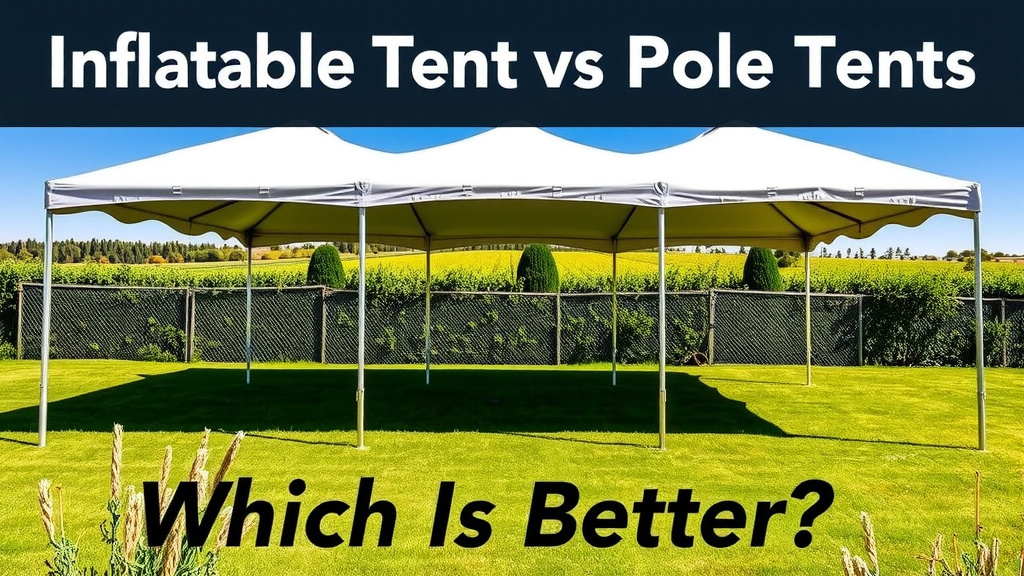
Inflatable Tent vs Pole Tent: Which Is Better?
Choosing between an inflatable tent and a traditional pole tent depends on what you value most: speed and ease, or classic reliability. Inflatable tents generally set up much faster, often in under 10 minutes, because you just pump them up. Pole tents might take a bit longer, but they’ve been around forever for a reason.
Both tent types offer shelter for your camping adventures. Your decision will likely hinge on factors like setup time, weight, and how much space you need. We’ve researched what campers love about each style to help you decide.
- Inflatable tents are super fast to set up.
- Pole tents are a trusted, long-standing option.
- Consider setup speed, weight, and interior space.
- Both offer great protection from the elements.
Let’s walk through exactly how each type stacks up so you can pick the perfect tent for your next trip.
Comparing Inflatable Tents to Traditional Pole Tents
So, you’re looking to buy a new tent and you’ve stumbled upon two very different types: the inflatable kind and the classic pole tent. It’s a common question for campers! Which one is truly better for your adventures? We’ve researched both to help you make the best choice for your needs.
How Inflatable Tents Work
Inflatable tents might seem like magic, but they’re pretty straightforward. Instead of metal or fiberglass poles, they use **airbeams**. You just hook up a pump and inflate these beams, and your tent structure pops right up. It’s like blowing up a giant, sturdy balloon that becomes your tent’s frame.
The Setup Speed Advantage
The biggest draw of inflatable tents is their **setup speed**. Forget fumbling with poles in the dark or wind. Most inflatable tents can be pitched in under 10 minutes, sometimes even faster. You literally just pump them up until they’re firm. This is a huge relief after a long day of driving or hiking.
Deflating and Packing
Packing up is just as easy. Most inflatable tents have special valves that let the air out quickly. You just open the valve, and the air rushes out. Then, you roll or fold the tent up. It’s usually much less fuss than trying to get poles back into their sleeves.
Weight and Portability
While the tent fabric itself can be heavy, the absence of poles can make the packed size surprisingly manageable. However, you do need to pack a pump, which adds a bit of weight and bulk. Some campers find the overall packed weight comparable to a pole tent, while others note it’s slightly lighter if they use a manual pump.
Durability Concerns?
You might wonder if airbeams are as tough as poles. Many manufacturers use **high-quality, reinforced TPU** (thermoplastic polyurethane) for their airbeams, which is very durable. Of course, any material can be punctured. Most inflatable tents come with a patch kit, and repairs are often simple, similar to fixing an air mattress.
Understanding Traditional Pole Tents
Pole tents are the veterans of the camping world. They’ve been providing shelter for generations of campers. Their structure relies on a network of poles, usually made of fiberglass or aluminum, that slide through sleeves or attach to clips on the tent fabric.
The Reliability Factor
Pole tents are known for their **reliability and stability**. Because they use a rigid structure, they can often withstand stronger winds than some lighter inflatable designs, especially if they are well-guyed out. You know exactly what you’re getting with a pole tent – a tried-and-true system.
Setup Process: Practice Makes Perfect
Setting up a pole tent does take more time and effort. You’ll need to assemble the poles, thread them through the tent sleeves or attach them to the clips, and then stake the tent down. For beginners, this can be a bit tricky, especially in less-than-ideal weather. It often takes 15-30 minutes, sometimes longer for larger tents. However, many seasoned campers find the process almost meditative, and with practice, it becomes quite quick.
Repairing Damage
If a pole breaks, it can be a bigger issue. While you can often get replacement poles or repair sleeves, it might mean a trip to the outdoor store or a more involved fix in the field. Fabric tears can be repaired with patch kits, similar to inflatable tents.
Weight and Packability
Pole tents can vary greatly in weight. Lightweight backpacking models are very compact. Larger family camping tents can be quite heavy due to the poles and larger amounts of fabric. The poles themselves add a significant amount of weight and bulk to the packed tent.
Key Differences at a Glance
Let’s break down the core differences you’ll encounter when choosing between these two tent styles. Think about what matters most for your camping trips.
| Feature | Inflatable Tent | Pole Tent |
|---|---|---|
| Setup Speed | Very Fast (under 10 minutes typical) | Slower (15-30+ minutes typical) |
| Setup Ease | High (pump and inflate) | Moderate to High (requires assembly) |
| Packability | Good, but requires pump | Varies widely, poles add bulk |
| Durability | Good, airbeams can be strong | Good, rigid poles are sturdy |
| Repairability | Easy for airbeams (patch kit) | Poles can be harder to fix in field |
| Cost | Often Higher initial cost | Varies widely, can be cheaper |
Making Your Final Decision
When it comes down to it, the best tent for you depends on your camping style. Are you someone who wants to get to the campsite and relax as quickly as possible? An inflatable tent might be your perfect match. The speed and ease of setup are unmatched, especially if you’re arriving late or dealing with kids who are eager to play.
On the other hand, if you value a long-standing, traditional camping experience, or if you often camp in areas known for very high winds and want the reassurance of a rigid pole structure, a pole tent could be the better choice. Many campers have also used pole tents for decades and are just comfortable with the familiar setup process.
Your Tent Checklist
To help you decide, ask yourself these quick questions:
- How important is lightning-fast setup after a long travel day?
- Do you prefer a tent that’s super simple to pitch, even if you’re new to camping?
- Are you worried about breaking poles in rough conditions?
- Does the idea of packing an extra item (the pump) bother you?
- What’s your budget, and are you looking for the absolute newest technology?
- How often will you be camping, and in what types of weather?
By considering these points, you’ll be well on your way to choosing the tent that will serve you best on all your future outdoor adventures.
Conclusion
You’ve learned that inflatable tents offer incredible speed and ease of setup, perfect for when you want to relax quickly after a drive. Traditional pole tents, on the other hand, provide a time-tested reliability and sturdy structure that many campers trust. Your ideal choice really comes down to your personal camping priorities and how you like to spend your time outdoors. Consider how important setup speed is versus the familiar feel of a classic pole tent. When you’re ready, take a moment to list your top two priorities for a tent and see which type aligns best with your camping style.
Frequently Asked Questions
Can inflatable tents withstand strong winds?
Many modern inflatable tents are designed with strong, reinforced airbeams that can handle windy conditions quite well. They often use robust guying systems, similar to pole tents, to increase stability. However, extremely high winds might still challenge any tent, and proper setup is key.
How do I repair a puncture in an inflatable tent’s airbeam?
Most inflatable tents come with a patch kit, much like you’d use for an air mattress or inner tube. You typically clean the area, apply a patch with adhesive, and let it set. For larger tears, specialized repair tape or professional repair services are options.
Are pole tents really that much harder to set up than inflatable ones?
Setting up a pole tent generally takes more steps and physical effort than an inflatable tent. You need to assemble poles, thread them through sleeves, and then stake the tent. While it might be slower initially, many campers find it becomes a familiar and efficient process with practice.
Which type of tent is generally lighter to carry?
This can vary greatly depending on the specific tent model and size. While inflatable tents eliminate the weight of poles, you must carry a pump. Pole tents can be very lightweight for backpacking or quite heavy for larger family models. It’s best to check the packed weight of specific models you are considering.
Can I use an electric pump to set up an inflatable tent?
Yes, many campers find using a portable electric pump makes setting up an inflatable tent even faster and easier. Just ensure you have a way to power it, like a car adapter or a battery-powered unit. Remember to still monitor the pressure to avoid over-inflation.

![7 Best Pop Up Privacy Tent [2026]](https://leonardhomeoutdoor.com/wp-content/uploads/2026/09/7-best-pop-up-privacy-tent-2026-featured-768x432.jpg)
![7 Best Car Top Tent [2026]](https://leonardhomeoutdoor.com/wp-content/uploads/2026/08/7-best-car-top-tent-2026-featured-768x432.jpg)
![7 Best A Frame Tent [2026]](https://leonardhomeoutdoor.com/wp-content/uploads/2026/08/7-best-a-frame-tent-2026-featured-768x432.jpg)